Google changes its search results every day. Most changes are tiny. A few times a year, though, it releases a broad core update: a change to its main ranking systems that can move a site up or down noticeably within days.
Before 2019, these changes usually went unnamed and SEO forums gave them nicknames. On 12 March 2019 Google confirmed a broad update and named it the March 2019 Core Update. From then on, core updates were announced, named by month, and tracked. This article lists every one since, and explains what to do when one affects you.
What a core update is, in plain words
Google's own comparison is a list of the top 100 films made in 2015. If you remade the list in 2019, some great new films would enter and some old ones would move down. The old films did not get worse; the list was simply re-judged.
A core update works the same way. It does not target one industry, one site or one trick. It changes how Google judges relevance and quality across the whole web, so some pages move up and others move down.
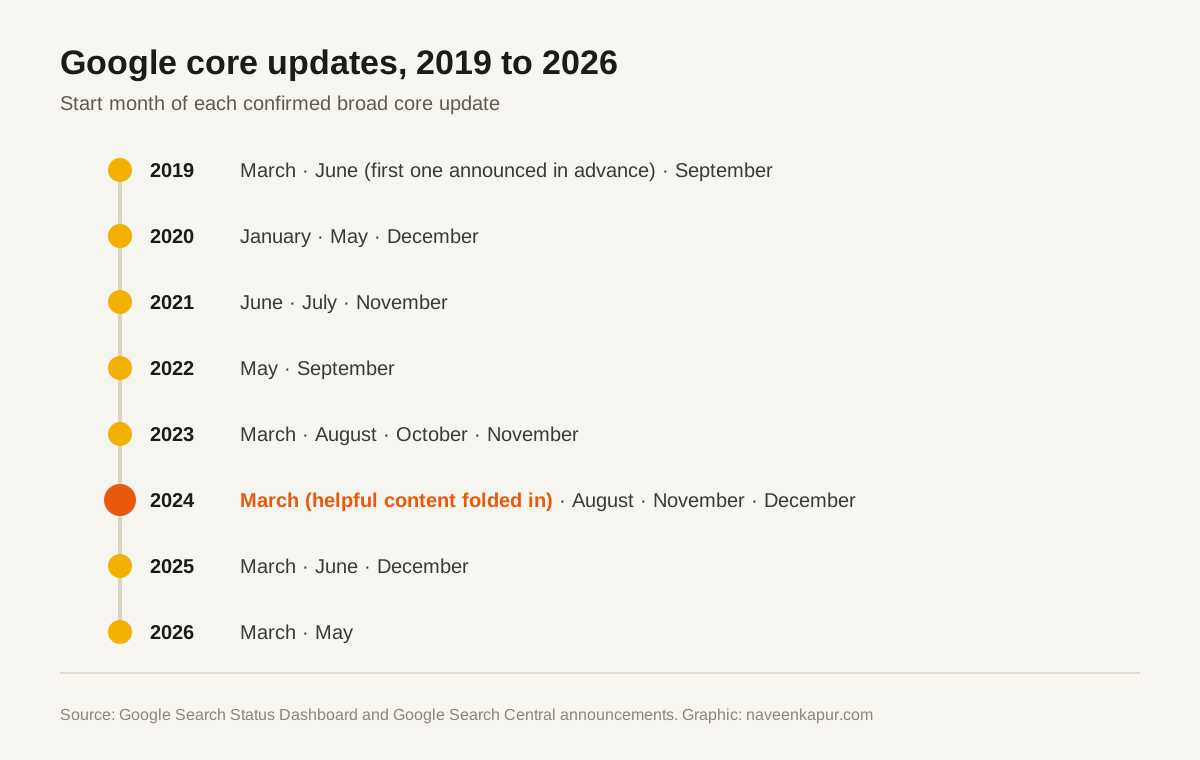
Every confirmed core update since 2019
| Year | Core updates (start date) | Worth knowing |
|---|---|---|
| 2019 | 12 Mar · 3 Jun · 24 Sep | June 2019 was the first core update Google announced a day in advance. |
| 2020 | 13 Jan · 4 May · 3 Dec | May 2020 landed in the middle of the pandemic, when search behaviour had already shifted. |
| 2021 | 2 Jun · 1 Jul · 17 Nov | June and July were planned as one update split in two. |
| 2022 | 25 May · 12 Sep | Google also launched the separate helpful content system in August 2022. |
| 2023 | 15 Mar · 22 Aug · 5 Oct · 2 Nov | Four core updates, plus a big helpful content update in September. |
| 2024 | 5 Mar · 15 Aug · 11 Nov · 12 Dec | March 2024 folded helpful content into core ranking and took until 26 April to finish. |
| 2025 | 13 Mar · 30 Jun · 11 Dec | Each took two to three weeks to roll out. |
| 2026 | 27 Mar · 21 May | Google also ran a separate Discover core update in February 2026. |
The update that changed the most: March 2024
In August 2022 Google had launched a separate helpful content system. It looked for sites with lots of content written mainly to rank in search rather than to help people, and could pull down a whole site.
With the March 2024 core update, Google stopped running it as a separate system and built its signals into core ranking. Google said that, together with new spam policies, it expected to cut low-quality, unoriginal content in results by 40%. When the rollout finished on 26 April 2024, it said the reduction was 45%.
At the same time Google added three spam policies that hit many SEO shortcuts head-on:
- Scaled content abuse
- Mass-producing pages mainly to rank, whether by people, software or AI. Old autoblog tools are exactly this pattern.
- Site reputation abuse
- Third-party pages placed on a trusted site to borrow its ranking power. Enforcement began in May 2024.
- Expired domain abuse
- Buying an expired domain and filling it with low-value content to ride its old reputation.

Core update or spam update?
Google also runs spam updates (for example in August 2025 and March 2026). They are different and need different responses:
| Core update | Spam update | |
|---|---|---|
| Targets | Overall relevance and quality | Pages that break spam policies |
| Is it a penalty? | No | It works like one for the pages caught |
| What to do | Improve content and usefulness | Remove the spammy practice |
| Manual action in Search Console? | Never | Only if a human reviewer acted |
How to check if a core update affected you
- 1Open Google Search Console → Performance. Compare the two weeks after the rollout finished with the two weeks before. Do not judge in the middle of a rollout.
- 2Check the Google Search Status Dashboard for the exact start and end dates.
- 3Look at which pages and which searches dropped. A drop on a few pages tells a different story than a drop across the whole site.
- 4Check for manual actions and security issues in Search Console. A core update never creates a manual action, so if you see one, the cause is something else.
- 5Rule out the obvious: tracking broke, a redesign, a robots.txt mistake, seasonal demand.
How to recover: Google's own questions
Google's guidance does not give a technical fix. It gives questions to ask honestly about your content. A short version:
- Does the page give original information, research or analysis, not just a rewrite of other pages?
- Does it give a complete, useful answer to the topic?
- Is it written by someone who clearly knows the subject, and does the site show who that is?
- Would a reader trust it enough to act on it, bookmark it or share it?
- Is the page made mainly for people, or mainly to attract search visits?
- Is the page free of distractions, too many ads and spelling or style problems?
What does not work
- Changing publish dates without changing the content.
- Adding word count for its own sake.
- Buying links or using black hat techniques to “push back” rankings.
- Copying the page that now ranks above you.
Solid basics still matter. On-page optimisation, a fast site that passes Core Web Vitals, and pages that work on phones (mobile-first indexing) will not rescue weak content, but they stop good content from being held back.