Links have been part of Google since the start. Its founders built PageRank on the idea that a link from one page to another is a kind of vote. Google's ranking systems guide still lists link analysis and PageRank among its core systems. Where there are votes, there are people trying to buy them.
By 2021, a whole industry sold “guest posts”, “DA 50 backlinks” and “link packages”. On 26 July 2021, Google announced the link spam update to make such links count for nothing. This article covers that update, the stronger December 2022 version, and the practical line between safe and unsafe links.
The July 2021 link spam update
Google's post, by Search Quality Analyst Duy Nguyen, was called “A reminder on qualifying links and our link spam update”. It had two parts.
Part 1: a reminder on money links
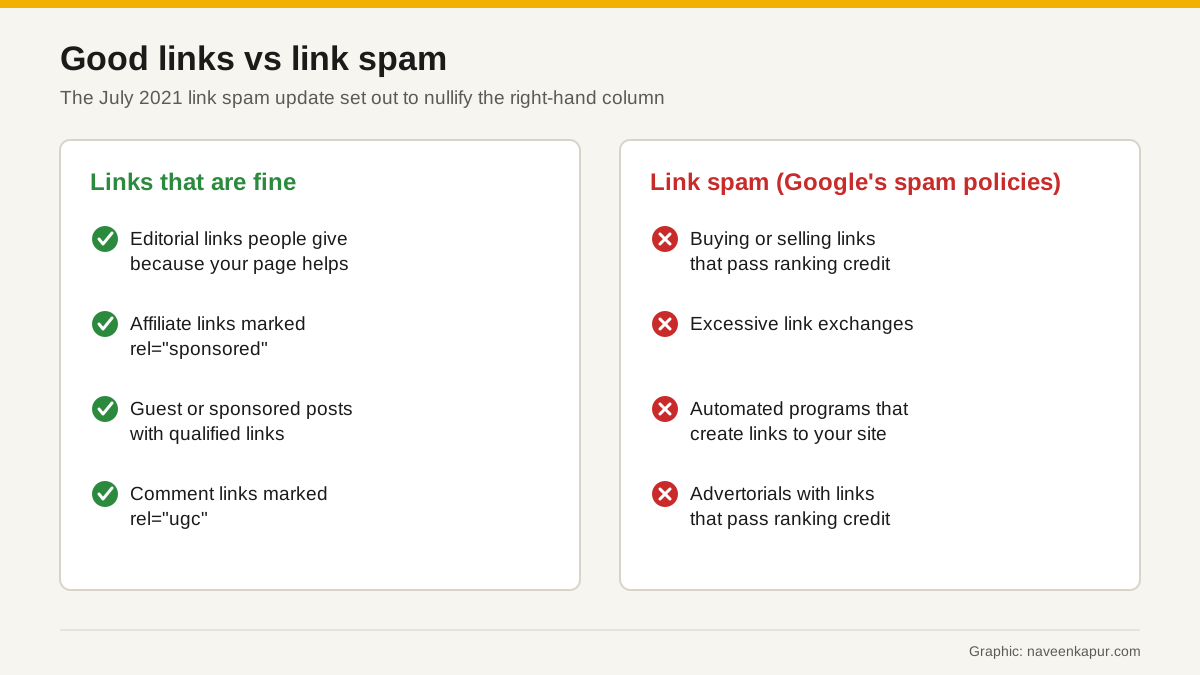
- Affiliate links are a fine way to earn money, but Google asks sites to mark them rel="sponsored", whether added by hand or automatically. Where sites fail to do this, Google may issue manual actions and its systems may take algorithmic action.
- Sponsored and guest posts: Google said it had seen campaigns of low-quality sponsored and guest posts made mainly to gain links. It strongly recommended proper rel values on those links. Excessive sponsored or guest posting without proper link tags could lead to algorithmic and manual actions.
Part 2: the algorithm update
Google called it a new link spam fighting change, “even more effective at identifying and nullifying link spam more broadly, across multiple languages”. It would roll out over the following two weeks. Sites taking part in link spam, Google said, “will see changes in Search as those links are re-assessed by our algorithms”.
The December 2022 link spam update and SpamBrain
On 14 December 2022, Google released the December 2022 link spam update. This time it used SpamBrain, Google's AI-based spam-prevention system. Google said SpamBrain could now detect both sites buying links and sites used for the purpose of passing outgoing links.
Google said the rollout would take about two weeks, would affect all languages, and that rankings may change as spammy links are neutralised and any credit passed by these unnatural links is lost.
| July 2021 | December 2022 | |
|---|---|---|
| Launch date | 26 Jul 2021 | 14 Dec 2022 |
| Rollout | About two weeks | About two weeks |
| Languages | Multiple languages | All languages |
| Method | Algorithm change to identify and nullify link spam | SpamBrain detects link buyers and link sellers |
| Effect | Spam links re-assessed and nullified | Spam links neutralised; credit they passed is lost |
What counts as link spam
Google's spam policies define link spam as creating links to or from a site primarily to manipulate search rankings. Examples Google lists include:
- Buying or selling links for ranking purposes, including paying money, giving goods or services, or sending a free product in exchange for a post with a link.
- Excessive link exchanges (“link to me and I'll link to you”) or partner pages made only for cross-linking.
- Using automated programs or services to create links to your site.
- Requiring a link as part of terms of service or a contract without letting the content owner qualify it.
- Text adverts or text links that don't block ranking credit.
- Advertorials or native adverts where payment is received for articles with links that pass ranking credit.

What the update means for a normal business
Two things follow from Google's wording. First, the main effect is that spam links are ignored: they stop helping. If a site's rankings were built on bought links, they can fall when that credit disappears, even with no manual penalty. Second, manual actions are still possible where Google sees deliberate link schemes.
How to spot a link spam offer
Most offers that land in a business owner's inbox fit one of Google's link spam examples. Warning signs:
- A price list per link, often by “DA” or “DR” score.
- A promise that links will be “dofollow” or “permanent”.
- Sites that publish posts on any topic for anyone who pays.
- “Link exchange” or “partner page” requests from unrelated sites.
- Software or services that create hundreds of profile, forum or directory links for you.
Paying for visibility is not wrong in itself. Sponsorships and paid posts are normal marketing. The rule is that a paid link must be marked so it does not pass ranking credit.
Safe ways to earn links
- 1Publish something worth linking to: original data, a useful calculator, a clear guide, real photos.
- 2Tell people about it through PR, industry associations, events and partners. Google itself says to promote awareness of your site using appropriately tagged links.
- 3Mark anything paid. Sponsorships, paid posts and affiliate links get rel="sponsored". Our guide to rel="sponsored" and rel="ugc" explains each value.
- 4Get the basics right so the links you earn send visitors to fast, useful pages. A good starting point is a proper SEO audit.
For a look back at how link tactics developed, see our archive post on black hat SEO techniques. Many of the methods described there are exactly what the link spam updates were built to neutralise.