On 18 August 2022 Google published a post titled “More content by people, for people in Search”. It announced the helpful content update, aimed at content that seems to be made mainly to rank in search engines rather than to help people. The rollout began on 25 August 2022 and finished on 9 September 2022.
Most Google updates judge pages one at a time. This one was different, and that is why it worried so many site owners.
What made it different: a site-wide signal
Google's Search Central post on the update explained that it introduced a new site-wide signal. Its systems automatically identify content that has little value or is not helpful to searchers. Then, in Google's words, any content on sites determined to have relatively high amounts of unhelpful content overall was less likely to perform well, not just the unhelpful pages.
Three more details from Google matter:
- It was automated. A machine-learning classifier, not a person, made the judgement. It was not a manual action or a spam action.
- It ran continuously. The classifier kept checking new and existing sites, and a site could see the signal applied over a period of months.
- It could lift. As the system saw that unhelpful content had not come back in the long term, the classification would stop applying.
Every helpful content update
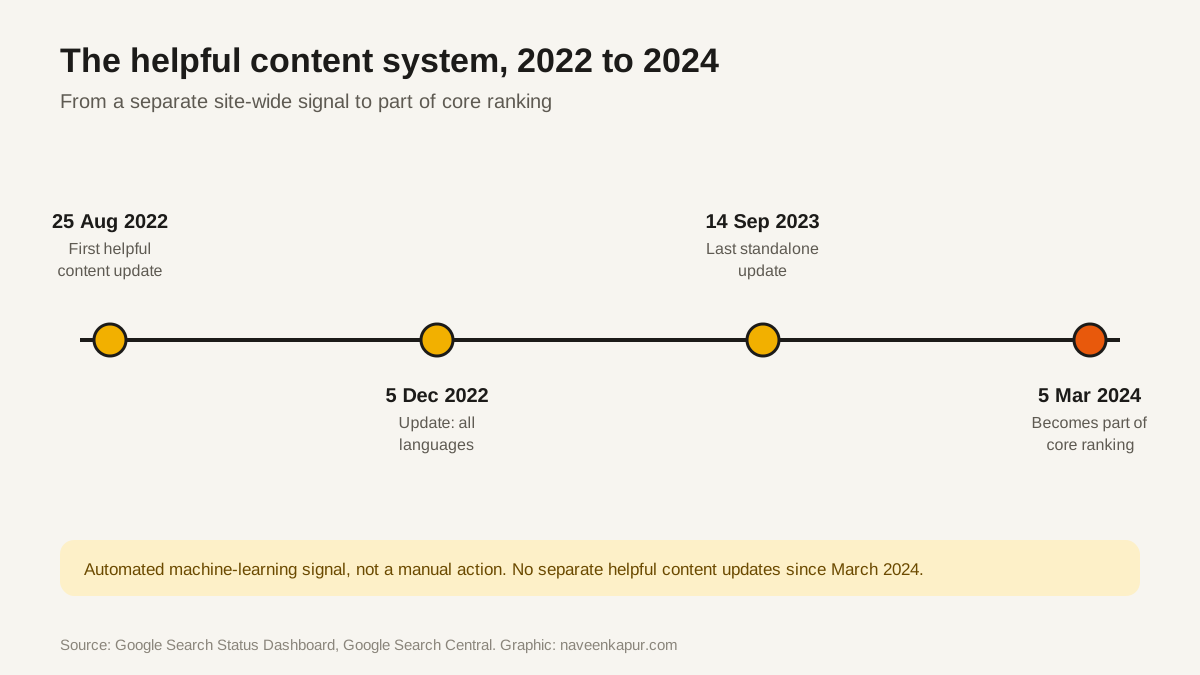
| Update | Started | Finished | Notes |
|---|---|---|---|
| August 2022 helpful content update | 25 Aug 2022 | 9 Sep 2022 | First launch, English-language searches |
| December 2022 helpful content update | 5 Dec 2022 | 12 Jan 2023 | Improved classifier; worked globally in all languages |
| September 2023 helpful content update | 14 Sep 2023 | 28 Sep 2023 | Last standalone update |
| March 2024 core update | 5 Mar 2024 | 19 Apr 2024 | Helpful content system became part of core ranking |
Google's ranking systems guide now lists the helpful content system under retired systems. It says that in March 2024 the system evolved and became part of Google's core ranking systems. So when someone says their site was “hit by the helpful content update” today, they usually mean a core update.

What “search engine-first” content looked like
Google's guidance listed warning signs that content is made for search engines first. In plain terms:
- Lots of content on many unrelated topics, hoping some of it ranks.
- Heavy automation to produce pages on many topics.
- Summarising what others say without adding anything new.
- Writing about trending topics only because they are trending, not because your audience needs them.
- Leaving readers feeling they need to search again to get a real answer.
- Writing to a word count because you heard Google prefers it (Google says it does not have a preferred word count).
- Promising answers to questions that have no answer, such as a release date that has not been announced.
How to check your own site
- 1List your pages by traffic and purpose. Which pages exist to help a customer, and which exist only to catch searches?
- 2Read the weakest pages as a customer would. Would you bookmark them or share them? Do they add anything that other pages do not?
- 3Improve, merge or remove. Make thin pages genuinely useful, combine near-duplicates, and remove pages that serve no reader.
- 4Show who wrote it and why. Real authors, first-hand experience and clear sources. See our guide to E-E-A-T.
- 5Stay in your lane. Write about what your business really knows.
What it means now
Since March 2024, helpfulness is judged as part of core ranking, alongside many other signals. The advice has not changed: make content for people, by people who know the subject, and make it better than what already ranks. With AI Overviews answering simple questions on the results page, pages that offer real depth and experience have the strongest reason to exist.