
Ask an admissions head in India which CRM they use, and LeadSquared will come up often. Search data says the same: in India, “leadsquared” is searched about 90,500 times a month and “leadsquared crm” about 1,000 times (OpenSEO, October 2026). Many of those searches come from people who already use it, or who have been told to look at it.
This article does three things. It explains what LeadSquared says its education product does, using only its own pages. It lists the problems institutes usually hit after buying any admissions CRM, because those decide whether the money is well spent. And it gives a fair way to compare LeadSquared with the alternatives. It is not a ranking and there is no sponsored placement here.
What LeadSquared is
LeadSquared is a sales execution and CRM platform built in India. Its company story page says LeadSquared launched in 2013, growing out of a company founded in 2011. It serves many industries, and higher education is one of its largest. Its higher education admissions page says it is trusted by 847 higher education institutions, while its higher education hub page says 500+ institutions. Different pages give different numbers, so treat any count as the vendor's own claim.
What its admissions CRM offers, in its own words
From LeadSquared's higher education pages, these are the main parts an institute buys:
- Lead capture: the page says it captures student leads automatically from sources such as social media, ads, websites and education marketplaces, with “automated inquiry capture from 20+ sources”.
- Student portal: online application with document upload, so the student does not need a separate form tool.
- Communication: email, SMS, WhatsApp and personalised microsites.
- Counsellor management: automated follow-up reminders, and real-time dashboards and reports that track counsellor performance and conversion.
- Calling: connectors for telephony, and the option to send a list to a call centre application for automated dialling.
- Mobile: a counsellor app for field events, fairs and travel.
- AI add-ons: an AI voice bot, AI lead propensity and AI call analytics, listed as optional add-ons to its higher plans.
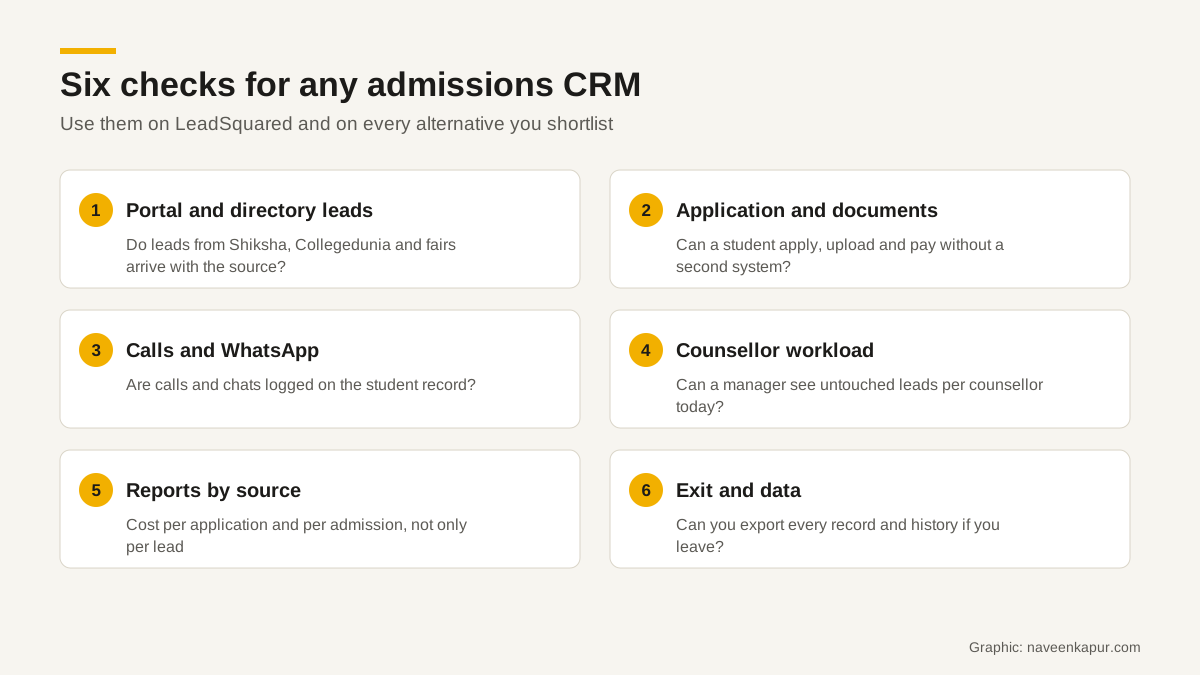
None of the LeadSquared pages checked for this article names a specific Indian portal such as Shiksha or Collegedunia. If portal leads matter to you, and for most Indian colleges they do, ask the sales team to show the exact connector working, with the source and the campaign arriving on the record.
Pricing
LeadSquared publishes education pricing on its US site: a Pro plan at $14,400 a year and a Super plan at $18,000 a year, each for up to 10 users, with a “Let's Talk” button for both. No Indian price list was found on its site. For an Indian institute, pricing is a conversation with sales, so get the quote in writing with the user count, add-ons, WhatsApp and telephony costs, and the renewal terms.
Where institutes struggle (with any admissions CRM)
Admissions teams rarely fail because a CRM lacks a feature. They fail because of how the CRM was set up and used. These are the problems that come up again and again in college admissions, and they apply to LeadSquared and every alternative equally.
1. Leads arrive without a usable source
If a lead says “Website” and nothing else, you cannot tell whether it came from a Google Ads campaign, an organic blog page or a portal listing. Every lead needs a source, a medium and a campaign stored when it is created, not typed in later by a counsellor. Without that, the cost per admission by channel is a guess. On the website side, Google Analytics 4 can pass campaign details into the form if it is set up properly.
2. Enquiries nobody touches
In peak season, a counsellor can have hundreds of open enquiries. The ones that never get a first call are the most expensive leads you have, because you paid for them and got nothing. The CRM must show untouched leads per counsellor today, and someone must own that report.
3. Duplicate students
The same student fills your form, enquires on two portals and walks in at a fair. Without a duplicate rule on mobile number and email, three counsellors call one student, and your reports count three leads. Decide the rule before go-live: which record wins, and who keeps ownership.
4. The admission is never linked back
A CRM that stops at “application submitted” cannot tell you what an admission costs, and your ad campaigns keep optimising for form fills instead of students. A good Google Ads expert will ask for this link first. The stage that matters is fee paid and enrolment confirmed. If accounts and the registrar work in a different system, plan how that status comes back to the CRM record. Our guide on CRM for colleges walks through the full set of stages.
5. Too many custom fields, too little training
It is tempting to add every field anyone asks for. Counsellors then skip fields, and reports fill with blanks. Start with the fields you will report on, train by role, and add more after the first admission cycle.

The alternatives, described by their own vendors
| Product | How the vendor describes it | Worth a look if |
|---|---|---|
| Meritto | “India's leading AI-powered Enrollment Automation Platform for Higher Education” (the company's legal name is NoPaperForms Solutions Limited) | You want an India-focused platform built only for education |
| ExtraaEdge | “An exclusively designed CRM for the higher education segment”, with lead channel integration, auto-allocation and digital application forms | You want an education-only CRM and a smaller vendor |
| Salesforce Education Cloud | Modules for recruitment and admissions, academic operations, student success, student financials, and advancement and alumni relations | You want one platform from enquiry to alumni and have the budget and partner to run it |
| Zoho CRM | “A customizable CRM for schools and universities” | You already use Zoho apps or want a lower cost of entry and are ready to configure it |
| HubSpot | A general CRM with education use cases: organise contacts, automate communications, boost enrolment | Your team is marketing-led and comfortable with HubSpot's tools |
Education-only products such as LeadSquared's education edition, Meritto and ExtraaEdge come with admissions stages, application forms and counsellor reports ready to use. General platforms such as Salesforce and Zoho give you more freedom and connect to more business software, but someone has to configure the admissions process. Neither type is better in general. The right one is the one your team will use every day.
How to run a fair comparison
- 1Send every vendor the same written brief: your lead sources, number of counsellors, programmes, application steps and the reports you need.
- 2Ask for the demo on your own data: 50 real enquiries from last season with names masked.
- 3Watch a portal lead and a Google Ads lead arrive live, and check the source, medium and campaign on the record.
- 4Ask the vendor to show untouched leads per counsellor, and cost per application by source.
- 5Get the full price for three years, including users, WhatsApp, telephony, AI add-ons and implementation.
- 6Ask how you would export every record, note, call log and chat if you leave, and in what format.
- 7Speak to two institutes of your size that use it, chosen by you, not only the references the vendor offers.
So, is LeadSquared right for your college?
LeadSquared offers what most Indian admissions teams ask for, and many institutes use it. Whether it is right for you depends on your sources, your team's habits, the price you are quoted, and how well it is set up. The same is true of every alternative. Use the six checks above, insist on a demo with your own data, and plan the setup and training as carefully as the purchase. If you want an outside view on how an admissions CRM should be set up for your institute, the colleges and universities service page explains how that work is done.