
Ask any school or college accounts head about their hardest month, and the answer is usually the one with a fee deadline. Parents queue at the counter, phones ring about receipts that never arrived, a fine is disputed, and someone in admissions is asked to “waive it just this once”.
A fee management system, whether part of a school ERP, a college CRM or a separate tool, should make that month calm. It cannot do that by technology alone. It needs clear rules, configured once and applied the same way for everyone. This guide sets out those rules.
1. Publish the fee schedule first
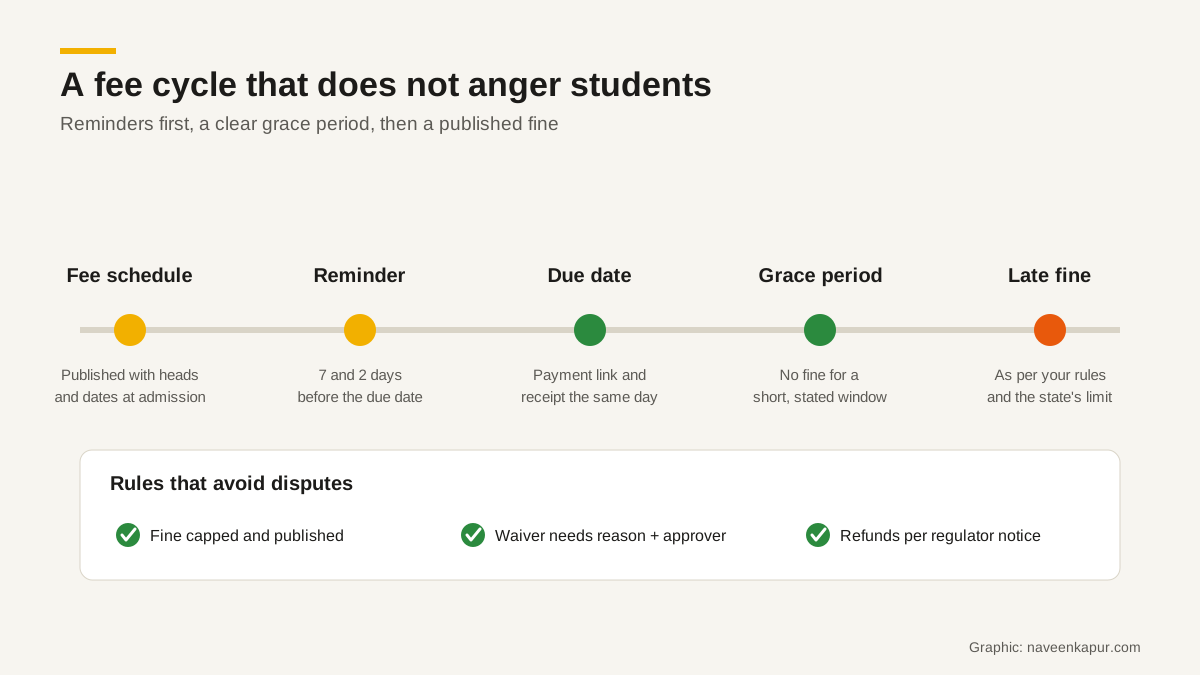
Most fee disputes start with surprise: a head nobody mentioned, a due date nobody saw. Give every family, at admission, a fee schedule that lists each head (tuition, transport, hostel, exam, activity), the amount, the due date for each instalment, the grace period, the late fine rule and the refund policy. Store it on the student's record, so the counter and the parent see the same thing.
For CBSE schools, the affiliation bye-laws say fees shall be charged under the heads prescribed by the state or UT Department of Education, and the school website should carry information on fees charged. Many states also regulate fee increases. Check what applies to you before you configure anything.
2. Remind before, not after
Most late payments are forgetfulness, not refusal. Set reminders that go out automatically: a week before the due date, two days before, and on the day, each with the amount, the heads and a payment link. Use the parent's preferred channel. If you send reminders on WhatsApp, use approved utility templates and keep a record of the parent's opt-in, as Meta requires; our guide to WhatsApp automation explains how.
3. Collect safely and receipt instantly
Online collection usually runs through a bank or a payment aggregator. The RBI's Payment Aggregator Directions, 2025 (15 September 2025) require non-bank payment aggregators to be authorised by the RBI; banks do not need separate authorisation for this business. Ask your provider for its authorisation status.
Then one technical rule that prevents many complaints: mark a fee as paid only when the payment is confirmed on your server, through the gateway's server notification or a status check, not because the parent's browser landed on a “success” page. Browsers close, networks drop and pages can be faked. Keep the payment page fast on a phone, too; slow pages fail Google's Core Web Vitals and lose payments as well as visitors. Once confirmed, issue the receipt immediately by email or message, and update the student's record so admissions and the counter see it too.
For recurring fees such as monthly transport, e-mandates help. Under the RBI's Digital Payments E-mandate Framework, 2026 (21 April 2026), recurring transactions may be authorised without additional authentication up to Rs 15,000 per transaction. Above that, the payer authenticates each debit.
4. Grace period and late fines
A late fine is meant to encourage payment on time, not to raise revenue. The rules that keep it fair:
- State the grace period in the fee schedule, and do not fine within it.
- Publish the fine rule in advance: a fixed amount, or a per-day amount, and a cap.
- Follow the law that applies to you. States can regulate late fees. In Delhi, for example, a Directorate of Education order on a parent's complaint directed a school to charge late fees in accordance with Rule 166 of the Delhi School Education Rules, 1973, and said the school can charge 5 paise per day as a late fine.
- Calculate automatically, so every student is treated the same way.
- Show the fine separately on the invoice and receipt, never folded into tuition.
5. Waivers and concessions need a second person
Every institute gives concessions: siblings, staff children, scholarships, hardship cases. Problems start when they are given verbally. In the system, a waiver or concession should need a reason from a set list, the person who requested it, and an approver who is not the same person. Then report on concessions by approver every month. This protects staff as much as it protects the institute. Setting these rules is a normal part of a CRM project; see when a business needs a CRM consultant.

6. Refunds by the regulator's rules
Refunds cause the worst publicity when they are slow. For universities and colleges under UGC, the rules are written down. UGC's notice dated 27 October 2025 keeps its earlier fee refund policy in force for later sessions. Up to the notified cut-off date, a full refund of fees is to be made, with not more than Rs 1,000 deducted as a processing fee. For withdrawals after that, UGC's 2018 notification applies a sliding scale based on when the notice of withdrawal is received:
| Notice of withdrawal received | Refund of fees |
|---|---|
| 15 or more days before the formally notified last date of admission | 100% |
| Less than 15 days before that date | 90% |
| Up to 15 days after that date | 80% |
| 16 to 30 days after that date | 50% |
| More than 30 days after that date | 0% |
The same notification prohibits institutions from keeping students' original certificates. In the fee system, a refund is a tracked stage on the student's record: request date, calculated amount, approver, paid date. Our guide to closing the four-office gap shows how accounts, admissions and the registrar share that status.
7. Reports the accounts head should see
- Dues by class or programme, by age (not yet due, 0 to 15 days late, 16 to 30, over 30)
- Collections by day and by payment method
- Payments received but not yet receipted (should be zero)
- Fines charged and fines waived, by approver
- Concessions given, by type and approver
- Open refund requests, with days pending
Choosing a fee management system
- 1Can it hold your real fee structure, with heads, instalments and concessions by class?
- 2Does it mark payments only on server confirmation, and issue receipts automatically?
- 3Can the fine rule, grace period and cap be configured and shown to parents?
- 4Do waivers and refunds need an approver, with an audit trail?
- 5Is the fee status visible on the same student record admissions uses?
- 6What does the gateway charge per transaction, and who pays it?
Fees are a trust test. When families see clear rules, early reminders, instant receipts and fair refunds, collections improve without arguments. For the wider system, read school management system: what to check and CRM for colleges. To plan fee rules inside a CRM, see the CRM development service page.