For years, a common SEO deal went like this. A website with strong rankings, often a news site or a university portal, would host pages written by someone else: “best payday loans”, “top casino sites”, “best CBD oil”. The host got paid. The third party got pages that ranked far better than they could on their own domain. The reader got a page that had nothing to do with the site they thought they were reading.
SEOs called this parasite SEO. Google calls it site reputation abuse. On 5 March 2024 it became one of Google's spam policies.
What Google announced on 5 March 2024
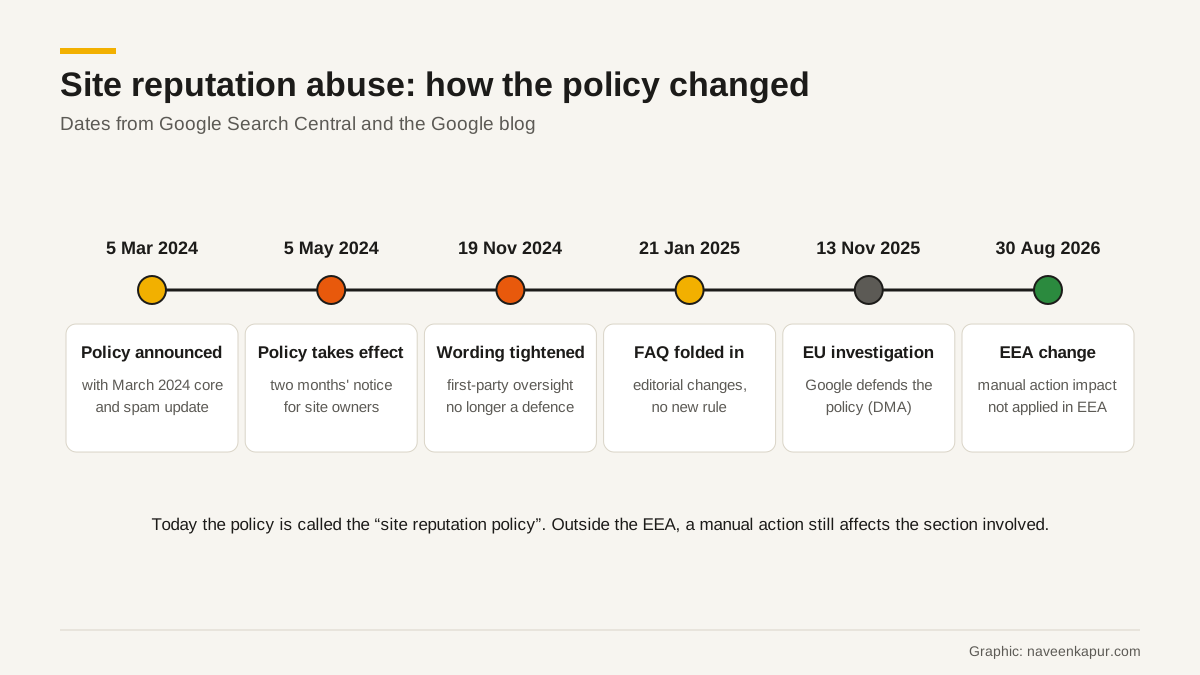
On the same day Google announced the March 2024 core update, it added three new spam policies: expired domain abuse, scaled content abuse and site reputation abuse. The Search Central blog post that day defined site reputation abuse as third-party pages published with little or no first-party oversight or involvement, where the purpose is to manipulate Search rankings by taking advantage of the first-party site's ranking signals.
Google gave site owners two months' notice. The post said the policy would take effect starting 5 May 2024. The Google blog post the same day used a simple example: a third party publishing payday loan reviews on a trusted educational website to gain ranking benefits from that site.
Google also put a number on the wider effort. It expected the core update and its spam work together to reduce low-quality, unoriginal content in results by 40%. In an update dated 26 April 2024, Google said the rollout had completed on 19 April and the reduction was 45%.
What counts, and what does not
The important point is that third-party content is not spam on its own. Most websites have some: guest columns, freelance articles, syndicated news, sponsored posts, user reviews, forum threads. Google's spam policies page lists both sides.
| Likely a problem | Not a problem by itself |
|---|---|
| An educational site hosting sponsored payday loan reviews that the same third party sends to many other sites | Wire service and press release sites |
| A medical site hosting a low-quality “best casinos” page that is not part of the site and is there to rank | News sites carrying syndicated news from other publications |
| Unauthored affiliate articles that sit outside the site's sections and copy text from a marketplace | Forums, comment sections and other user-generated content |
| Coupon or deal sections copied from white-label services mainly to rank | Columns, opinion pieces and other editorial work |
| Advertorials or native ads written for the publication's own readers | |
| Affiliate links that are marked properly, and normal third-party ad units |
The test is intent and fit. Would the page exist on this site if it did not borrow the site's rankings? Does it match the site's subject, design, quality and editorial standards? Is it clear who wrote it and who is responsible for it?
19 November 2024: oversight is not a defence
After the first months of enforcement, many publishers argued that they did review the third-party content, or that the section was run under a licensing deal or a partial ownership agreement. On 19 November 2024 Google closed that door. Its Search Central post said that no amount of first-party involvement alters the fundamental third-party nature of the content when the aim is to exploit the host's ranking signals.
The updated wording became: publishing third-party pages on a site in an attempt to abuse search rankings by taking advantage of the host site's ranking signals. Google added that it does not take a site's own claims about how content was produced at face value.
The same post explained a separate idea that matters for every large site. Google has systems that try to understand when a section of a site is independent or very different from the main content, and can treat it like a standalone site. If traffic to such a section drops, that is not necessarily a penalty. It may simply mean the section no longer benefits from site-wide signals.
What happens when Google finds it
Site reputation abuse is mainly enforced through manual actions: a person at Google reviews the site and applies an action to the affected pages. The site owner sees it in the Manual Actions report in Search Console and gets a message. Google's help page for the report says the action affects the pages involved, and that repeated violations may lead to further actions or affect the whole site's ranking.
The fixes Google lists are practical:
- Move the content to a new domain of its own. If you link to it from the old site, use the nofollow attribute, and do not redirect the old URLs to the new site.
- Add a noindex rule to the content so it stays out of Google Search. Do not also block it in robots.txt, or Google cannot see the noindex.
- Rewrite it as real first-party content that fits your site.
- Remove it.
Then use Request Review in the Manual Actions report. Google's FAQ is clear that adding noindex does not remove the action automatically; you still need to reply and explain what you did.
Two moves do not work. Shifting the content to a subfolder or subdomain of the same site may be seen as an attempt to get around the policy, which can lead to broader action. Moving it to another established site may simply give that site the same problem.

2025 and 2026: the European chapter
On 13 November 2025 the European Commission opened an investigation into how Google applies this policy under the EU's Digital Markets Act. Google responded the same day in a blog post by Pandu Nayak, Chief Scientist for Search, titled “Defending Search users from ‘Parasite SEO’ spam”. He called the investigation misguided and said a German court had already dismissed a similar claim.
On 28 August 2026 Google published an update following its discussions with the Commission. Starting 30 August 2026:
- For searchers outside the EEA, a manual action under the policy still directly affects results for the part of the site involved. The rest of the site is not affected.
- For searchers inside the EEA, the impact of the manual action does not apply. The affected section may instead be separated in Google's systems so that, over time, it ranks on its own merits.
- Site owners are still told in Search Console, can still file a reconsideration request, and eligible sites can take disputes to mediation.
Google's policy page now calls it the site reputation policy and lists the factors a human reviewer looks at: whether the design and formatting match the host site, whether the quality matches, whether authorship and editorial responsibility are clear, and whether the same content appears on many other sites. Google says no single factor decides the case.
For readers in India, the practical rule has not changed. India is outside the EEA, so a manual action under this policy still affects how the involved pages appear in results here.
What this means for Indian publishers and businesses
Indian news portals, education sites and city guides were attractive targets for parasite SEO, because they carry strong authority and accept sponsored content. If you run such a site, check these before you accept the next sponsored article:
- 1Is the topic something your own readers come to you for?
- 2Will your team edit it, put a named author on it and stand behind it?
- 3Is the same article being sent to many other sites?
- 4Are paid links marked with rel="sponsored"? See our guide to rel="sponsored" and rel="ugc".
- 5Would the page make sense to a reader who arrives from your home page, not from Google?
If you are a business buying “guest posts on high-authority sites”, the same policy applies from the other side. Paying for placement on a site that has nothing to do with your subject is exactly the pattern Google describes, and paid links that pass ranking credit also fall under the link spam rules covered in our article on the link spam update.
How it fits with the rest of Google's quality work
Site reputation abuse is one piece of a long effort to reward pages made for people. The helpful content update targeted content written mainly to rank. Core updates reassess quality across the web. This policy closes a gap those systems found hard to handle: low-value pages that ranked only because of where they were hosted.