A new enquiry arrives at 11:40 am. Who calls? If the answer is “whoever sees it first”, you already have a routing problem. Some counsellors pick the easy leads, some leads wait until evening, and a few are never called at all.
Lead routing is the set of rules that decides which person owns each new lead, automatically, the moment it arrives. It is a small search term in India (about 50 searches a month, OpenSEO, October 2026), but for any admissions office or sales team it decides how fast leads are called. This guide explains the main methods, when each fits, and the rules that stop routing from breaking in real life.
What lead routing is, and why it matters
Every CRM has an owner field on a lead. Routing fills that field by rule instead of by hand. Good lead assignment rules do three jobs:
- Speed. The lead reaches a named person straight away, so the first call can happen while the student or buyer is still interested.
- Fairness. Leads are spread in a way the team accepts, so nobody feels cheated and nobody hoards.
- Accountability. Every lead has one owner, so you can measure who contacted what, and how fast.
Routing also depends on who can see what. If owners cannot see their own leads, or managers cannot see the team’s, the best rule fails. See CRM user roles and permissions for that side.
The main lead routing methods
1. Round robin
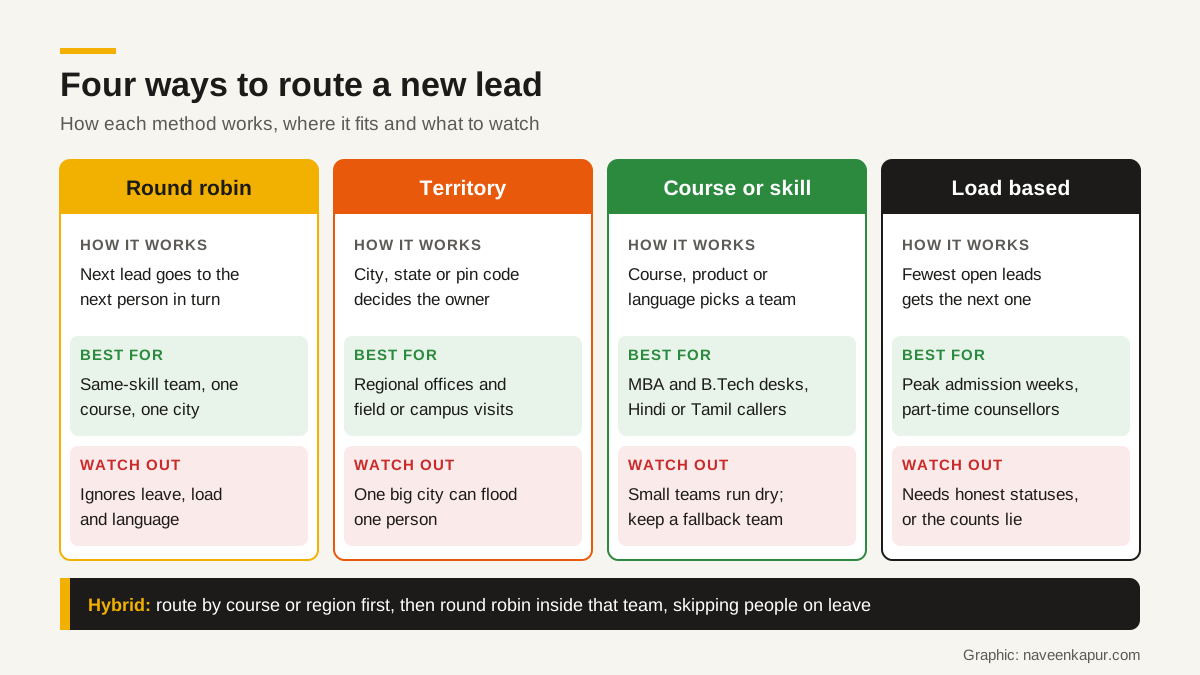
Round robin lead assignment gives each new lead to the next person in a fixed list, then starts again at the top. With four counsellors, lead 1 goes to A, lead 2 to B, and lead 5 back to A. It is simple to explain and hard to argue with, which is why most teams start here.
It fits a team where everyone sells the same thing with the same skill. It fails when people are on leave, handle different courses or speak different languages, because round robin knows none of that.
2. Weighted round robin
Weighted round robin gives some people more turns than others. For example (hypothetical), a senior counsellor gets two leads for every one that a new joiner gets, or a part-time caller gets half a share. It keeps the rotation but matches it to capacity. Review the weights every month, or they quietly become favouritism.
3. Territory based
Territory routing uses location: city, state or pin code. Leads from Rajasthan go to the Jaipur office; leads from a list of Delhi pin codes go to the counsellor who handles campus visits for that zone. It fits teams with regional offices, field sales or walk-in follow-up, where local knowledge matters. If your team books campus visits, territory routing pairs well with walk-in and campus visit tracking.
Watch out for uneven territories. One large metro can send more leads than five small states, so give big territories more than one owner and rotate inside them.
4. Course, product or skill based
Here the lead’s interest picks the team. MBA enquiries go to the MBA desk, B.Tech enquiries to the engineering desk, international programmes to the counsellor who knows visas. In sales, the product line or deal size does the same job. The lead reaches someone who can answer real questions on the first call.
5. Language based
In India, language often matters more than location. A parent in Chennai may prefer Tamil; a student in Lucknow may prefer Hindi. If your form asks for a preferred language, route on it. It is a small field that can change how the first call goes.
6. Load or capacity based
Load based routing sends the new lead to whoever has the fewest open leads right now. It suits peak weeks, such as the admission season rush after results, when some counsellors are buried and others are free. It only works if lead statuses are honest. If closed leads are left “open”, the counts are wrong and the routing punishes the people who update their records.
7. Hybrid
Most real teams combine methods. A common pattern: first route by course or region to the right team, then use round robin or load based lead distribution inside that team, and skip anyone on leave. This keeps expertise and fairness together.
Which method fits your team
| Situation | Good fit | Why |
|---|---|---|
| Small team, one course or product | Round robin | Equal skills, simple and fair |
| Mixed seniority or part-time staff | Weighted round robin | Shares follow capacity |
| Regional offices or field visits | Territory, then rotate | Local follow-up and visits |
| Many courses or product lines | Course or skill based | Expert answers on the first call |
| Parents and students across states | Language based | First call in a comfortable language |
| Admission season peak | Load based inside each team | Stops a few people being buried |
Rules that keep routing working
The method is half the job. These rules decide whether routing survives the first busy week.
- Leave and off-hours. Remove people on leave from the rotation automatically, not by memory. For leads that arrive at night, either hold them for the first person on shift or send an acknowledgement and route at opening time. Decide which, and write it down.
- Re-assignment when nobody calls. Set a contact target, for example (hypothetical) 30 minutes in working hours. If the owner logs no call or message by then, alert the team lead, and re-assign if it is still untouched after a second window. Keep a record of every re-assignment.
- Returning leads go to the existing owner. If a lead enquires again, match on phone and email and give it back to the person who already owns it, unless they have left or the lead has been inactive past your agreed limit. Do not create a new lead and a new owner.
- No cherry-picking. Counsellors should not pick leads from a shared pool. Assignment happens by rule; swaps go through the team lead and are logged.
- A fallback owner. Every rule needs a default owner or queue for leads that match no entry, so nothing sits without an owner.
How the big CRMs handle lead routing
The features differ by CRM and edition, so check your own plan. Here is what the official help pages say today.
Salesforce. Salesforce’s guidelines for assignment rules say that for each rule type, only one rule can be in effect at any time. That one lead assignment rule holds multiple rule entries, each with criteria and a sort order. If the rule cannot find an owner for a web lead, the lead goes to the default lead owner set in Lead Settings. Salesforce’s own help shows round robin built with an auto-number field and a formula using MOD, with one rule entry per user.
Zoho CRM. Zoho’s assignment rules can apply to all records or only to records that match criteria, and assign to users, roles or groups. When several users are selected, records are assigned in a round robin pattern. You can check availability by online status, shift timing or both, and a default user receives the record when the selected user is unavailable. Note one detail: Zoho’s help says assignment rules run for records created through import, webform and API, not for records created manually.
HubSpot. HubSpot workflows have a “Rotate record to owner” action, which needs Sales Hub or Service Hub Professional or Enterprise. By default it assigns records equally among a selected team or users. In lead and ticket workflows you can choose load balanced, round robin or random distribution. With “Assign to available users only” turned on, users set to Away are skipped.
Whatever the platform, routing then hands over to follow-up automation: an approved WhatsApp acknowledgement, a call task, a reminder. See WhatsApp automation for admissions and sales for that part, and CRM for colleges for the full enquiry to enrolment flow.

How to measure whether routing is fair and fast
Do not judge routing by “leads assigned per person”. That number shows the rule ran, not that it worked. Track these by owner, every week:
- 1First response time: time from lead created to first logged call or message, during working hours.
- 2Contact rate: share of assigned leads actually reached, not just dialled.
- 3Untouched leads: leads with no activity after your contact target.
- 4Re-assignments: how many leads were moved, and why.
- 5Conversion by owner and source: applications or deals from the leads each person received.
For example (hypothetical): if two counsellors each receive 200 leads in a month, and one reaches 150 while the other reaches 90, the rule was fair but the follow-up was not. That is a coaching conversation, not a routing change. If one counsellor keeps getting leads from a weak source, adjust the routing so lead quality is shared too.
In CampusFlow CRM, the education CRM Naveen Kapur designed for a training institute, webforms feed an automation builder that applies routing rules like these, with role-based access deciding who sees each lead. If you want routing rules designed and tested for your team on any platform, see the CRM development service.