Most restaurant marketing reports in India show reach, likes, followers and maybe clicks. None of these tells the owner the one thing that matters: how many people walked in and paid because of this spend. A reel can get thousands of views and fill no tables. A small Google Business Profile post can fill a Friday night, and nobody will know.
This guide shows a simple way to fix that. Treat a redeemed booking as the proof of footfall, give every channel its own code, and judge each channel on the guests it brings to the table. It works for a single café and for a hotel with three restaurants.
Why likes are the wrong scoreboard for restaurant marketing
Likes measure attention on a screen. Your restaurant earns money when a guest sits down, orders and pays. Between those two points there are many places to lose people: they see the post but never book, they book but never come, they come but the visit is never linked to the post. If you only count the first step, every channel looks good, and you cannot decide where the next rupee should go.
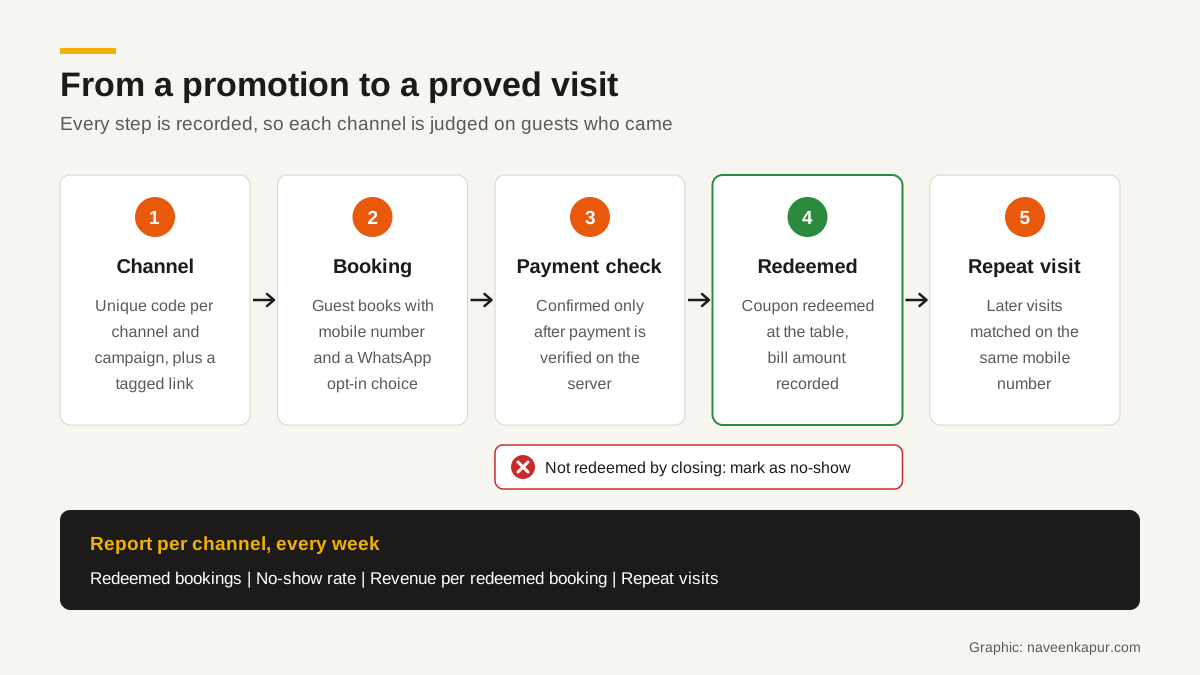
A better scoreboard follows the guest all the way: booking made, booking confirmed, guest arrived, coupon redeemed, bill paid, guest came back. Each step is a number you can record. Together they show which channel produces real restaurant footfall and which only produces noise.
- Redeemed booking
- A booking or coupon that was used at the table, with the bill raised against it. This is the visit you can prove.
- No-show rate
- Confirmed bookings where the guest did not arrive, divided by all confirmed bookings, for the same channel and period.
- Revenue per redeemed booking
- Total bill value of redeemed bookings from a channel, divided by the number of those bookings.
- Repeat visit
- A second or later visit by the same guest, matched on mobile number, within a period you choose (for example 90 days).
Coupons and prepaid bookings as proof of footfall
Restaurant coupons are often treated as a discount tool. Used well, they are a measurement tool. A coupon with a unique code links a specific promotion to a specific visit. When the server or cashier marks it as redeemed and enters the bill, you know that this person came, what they spent, and which campaign brought them.
Prepaid bookings go one step further. A guest who has paid a deposit or bought a set menu in advance is far more likely to turn up, and you hold a record of the payment. The rule that matters is simple: a prepaid booking is confirmed only after the payment is verified on your server, not when the guest’s browser shows a success page. Browsers close, networks drop and screenshots can be edited. Our guide on payment gateway integration explains why server-side checks matter.
How to set up the measurement before you spend
- 1One code per channel and campaign. Instagram Diwali offer, Google Business Profile weekend post, WhatsApp birthday message and Google Ads lunch campaign each get their own code. Never reuse a code across channels, or the data mixes.
- 2One tagged link per channel. Add UTM parameters (utm_source, utm_medium, utm_campaign) to every booking link you place in bios, posts, ads and messages, so your analytics tool shows where booking-page visits came from. The GA4 setup checklist covers the basics.
- 3Capture the mobile number at booking. It is the key that links a booking, a visit and a repeat visit in India, where most guests share a phone number more readily than an email.
- 4Redeem at the table, with the bill. When the bill is raised, staff enter the code, the system marks it redeemed and stores the bill amount. A code can be redeemed once. No code, no proof.
- 5Record no-shows the same night. Any confirmed booking not redeemed by closing time is marked as a no-show, per channel.
- 6Review weekly by channel. Bookings, confirmed, redeemed, no-shows, revenue per redeemed booking and repeat visits. Move money towards the channels that bring paying guests.
| Channel | Example code | Link tag (utm_source / utm_medium) | What you count |
|---|---|---|---|
| Google Business Profile post | GBP-WKND | google / business_profile | Redeemed bookings and bills |
| Instagram ad | IG-DIWALI | instagram / paid_social | Redeemed bookings, no-shows |
| WhatsApp to opted-in guests | WA-BDAY | whatsapp / message | Redeemed bookings, repeat visits |
| Google Ads local campaign | GADS-LUNCH | google / cpc | Redeemed bookings, cost per redeemed booking |
| Printed table card or flyer | PRINT-OCT | QR code to a tagged link | Redeemed bookings only |
Google Business Profile for restaurants
For most restaurants, the Business Profile on Google Search and Maps is the most important free channel, because people looking for a place to eat nearby see it first. Google’s Business Profile help for restaurants describes what you can manage:
- Menu: the menu editor lets you build a menu with sections, dishes, descriptions and prices, add a menu link, and upload menu photos.
- Reservations and ordering links: Google allows up to 10 links each for making reservations and placing food orders. Point the reservation link to your own tagged booking page, so bookings from the profile are counted.
- Posts: updates, offers and events. An offer post needs a title and dates, and can include a coupon code, a link and terms and conditions. Use a unique code here too.
- Photos and attributes: interior, exterior and food photos, plus attributes that describe what you offer.
- Reviews: you can reply to every review, positive or negative.
Our full guide to Google Business Profile covers verification and the rest of the setup.
WhatsApp follow-up, only after opt-in
WhatsApp is where most Indian guests confirm plans, so booking confirmations, reminders on the day and a thank-you after the visit work well there. Meta’s rules for the WhatsApp Business Platform say a business must get opt-in first, the opt-in must clearly name the business, and it must be clear that the person is agreeing to receive messages from it. Meta also advises telling people how to opt out and honouring those requests.
Add an unticked opt-in checkbox to the booking form, store it as a field on the guest record, and send offers only to guests who said yes. A reminder a few hours before the booking is one of the cheapest ways to cut no-shows. Read WhatsApp automation for templates, the 24-hour window and pricing.
Ask for reviews, within Google’s policy
Reviews decide many dining choices, so it is tempting to offer a free dessert for a five-star review. Google’s Maps user contributed content policy does not allow it. Merchants may not offer incentives such as payment, discounts, or free goods or services in exchange for reviews, and may not discourage negative reviews or selectively ask only happy guests for reviews. Reviews from current or former employees count as a conflict of interest.
What you can do: Google lets you create a review link or QR code from your Business Profile and share it on receipts, in thank-you messages or as a printed card. Ask every guest the same way, offer nothing in return, and reply to every review, including the bad ones. Keep the review request separate from your coupon offer, so nobody can read one as payment for the other.
Meta and Google Ads: judge local campaigns by bookings
Ad platforms report what they can see. Google Ads can count local actions such as direction clicks, call clicks, menu clicks and order clicks on your business location. These are useful signals of interest, but a direction click is not a visit, and a call is not a booking.
Close the gap with your own records. Each ad gets its own coupon code and tagged booking link, so you can count redeemed bookings and divide the spend by them. If you want the ad platform to learn from real visits, Meta recommends its Conversions API for sending offline and physical store events, and Google Ads has its own options for importing offline conversions. Send only events you have proved, such as redeemed bookings with a bill value, and follow each platform’s rules on consent and customer data.
Coupon terms that stay on the right side of consumer law
A coupon is a promise to the customer. Write the terms before you publish, and show them where the code appears:
- What the offer is, in plain words, and the price basis (for example, whether taxes and service charges are included).
- Valid dates, days and times, and the expiry date.
- Which outlets, menus or set meals it applies to, and the minimum bill, if any.
- Whether it can be combined with other offers, and the limit per table or per mobile number.
- For prepaid bookings: the cancellation and refund rule, stated before payment.
In India, the Central Consumer Protection Authority issued the Guidelines for Prevention and Regulation of Dark Patterns, 2023 on 30 November 2023, under the Consumer Protection Act, 2019. They list 13 specified dark patterns, including false urgency, drip pricing and bait and switch. For a restaurant, the practical lesson is simple: no fake countdown timers, no “only 2 tables left” unless it is true, and no charges that appear only at the payment step. If you are unsure about a term, ask a lawyer.
An example: proving visits for hotel restaurants
Naveen Kapur built a reservation and coupon CRM for the restaurants at Country Inn & Suites by Radisson, Sahibabad. Two rules sit at its centre. A booking is confirmed only after the payment is verified on the server. And each visit is proved by a redeemed coupon. With those two rules, a booking report stops being a list of intentions and becomes a list of guests who came.
Restaurant marketing ideas you can measure
Any of these restaurant marketing ideas can be tested with the setup above, because each one carries its own code:
- A weekday lunch set menu, sold as a prepaid booking, promoted on your Business Profile with its own code.
- A birthday or anniversary message on WhatsApp to opted-in guests, with a code valid for that month.
- A festival dinner sold in advance with a fixed number of seats and honest availability.
- A table card with a QR code for the next visit, valid after a set number of days, to measure repeat visits.
- A tie-up with a nearby office or hotel, with a code unique to that partner.
- A small Google Ads local campaign around lunch hours, judged only on redeemed bookings.
What to do next
Pick your codes, tag your links, train the staff who raise bills to enter the code every time, and record no-shows the same night. After a month you will know your cost per redeemed booking for each channel, and the decision about where to spend becomes easy. If you want help setting up the measurement or running campaigns that are judged on bookings, the digital marketing service page explains how that work is done.